Coconut Macaroons with Golden Edges and Chewy Centers
Coconut macaroons are small cookies with toasted coconut tips and a soft, chewy middle. They are useful on a Christmas cookie tray because their texture is very different from shortbread or crisp sugar cookies. The mixture uses shredded coconut, condensed milk and whipped egg whites, with a little salt and alcohol-free vanilla to round out the sweetness.
These are coconut macaroons, the rustic domed cookies, rather than French macarons made with almond flour and sandwich fillings. There is no piping or filling to organize. The main work is folding the mixture gently and making compact, evenly sized mounds.
The batch makes twenty-four small cookies, divided between two baking sheets. Baking both trays together keeps the cooking window manageable, while swapping their positions helps them color evenly. Let the cookies cool before moving them too much; warm centers are delicate even when the outside looks ready.
The texture to aim for
A good macaroon has distinct coconut strands on the outside and a moist center that holds together when bitten. The surface should turn golden at the tips, but the whole cookie should not become dark brown or dry.
Sweetened condensed milk helps bind the coconut and gives a gentle caramel note as the bases brown. Whipped egg whites add structure without making the mixture into a smooth dough. Medium-firm peaks are enough: the whites should hold a shape while the very tip bends slightly.
Compact scoops matter. Loose strands that stick far away from the mound brown before the center is ready. Tucking them in also makes the cookies easier to lift off the parchment once cooled.
Ingredients and useful buying notes
Use the exact quantities in the card below, especially the coconut and condensed milk. Their balance controls spreading.
- Sweetened shredded coconut, 300 g: Use ordinary medium shreds. Coconut flour, coconut flakes and fine desiccated coconut are different products.
- Sweetened condensed milk, 200 g: This is thick, sweet milk, usually sold in a can. Measure the amount rather than assuming the entire can is needed.
- Two large egg whites, about 60 g: Separate them carefully so there is no yolk in the bowl. Save the yolks for another cooked recipe.
- Alcohol-free vanilla flavoring, 5 ml: Check the label if avoiding alcohol.
- Fine salt, 1.5 g: It balances sweetness; it should not make the cookies taste salty.
The cookies contain egg and milk. Coconut may also be unsuitable for some households, so check individual needs before including them in a shared gift box. Do not describe them as allergy-safe simply because there is no wheat flour.
How to make coconut macaroons
1. Mix the coconut base and fold in the whites
Heat a conventional oven to 325 °F (165 °C), with racks in the upper and lower thirds. Line two baking sheets with parchment paper. Stir the shredded coconut, measured condensed milk and vanilla in a large bowl until no dry patches remain.
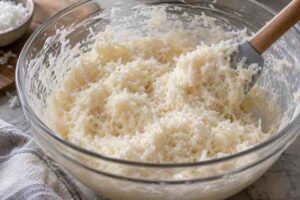
In a separate clean bowl, beat the egg whites with the salt until medium-firm peaks form. Fold a scoop into the coconut mixture to loosen it, then fold in the remainder with a spatula. Turn the bowl as you work and stop once the whites are evenly incorporated.
The mixture should look sticky and textured, with visible coconut strands. It should hold in a mound rather than pour like cake batter. Do not keep beating after the whites have been added.

2. Shape twenty-four compact mounds
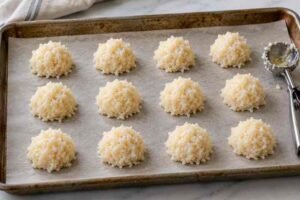
Divide the mixture into twenty-four portions, roughly 23 g each. A small cookie scoop is helpful, but two spoons also work. Place twelve mounds on each tray, leaving about 2 inches (5 cm) between them.
Gently press the mixture into rounded domes without flattening it into discs. Tuck stray coconut strands against the sides. Similar sizes help the coconut macaroons bake together and make the per-cookie nutrition estimate more useful.

3. Bake until golden and let them cool
Bake both trays for 25–28 minutes. About halfway through, swap the upper and lower trays and rotate them front to back. Look for golden tips, lightly browned bases and centers that have set rather than a glossy wet egg mixture.
For an additional check, insert an instant-read thermometer into the center of a larger cookie; it should reach at least 160 °F (71 °C). The FDA’s egg safety guidance recommends this temperature for dishes containing eggs.
Let the cookies stand on the trays for ten minutes before lifting them carefully onto a rack. Cool for another ten minutes or until fully set. They become easier to handle as the centers cool.

Substitutions and optional finishes
Do not replace condensed milk with evaporated milk. Evaporated milk is much thinner and is not sweetened in the same way; it can turn the mixture loose instead of binding it.
Unsweetened shredded coconut also changes sweetness and moisture. This formula is written for sweetened shreds, so use a recipe designed for unsweetened coconut if that is the product you have. Fine coconut flour is especially unsuitable as a direct replacement.
For a chocolate finish, drizzle a little melted dark chocolate over completely cooled cookies, then let it set. Chocolate is optional and is excluded from the base nutrition estimate. Keep the coating light so the toasted coconut texture remains visible.
A small pinch of finely grated orange zest can add aroma without making the mixture wet. Avoid pouring in citrus juice or additional milk. The base already contains the moisture it needs.
Troubleshooting
The cookies spread into flat puddles. Too much condensed milk or too little coconut can loosen the mixture. Weigh both ingredients and use shredded coconut rather than flakes. Compact the scoops and avoid adding the liquid at the bottom of the bowl separately.
The tips burn before the centers set. Loose strands or a hot oven are common causes. Tuck the strands in and check the actual oven temperature. Rotate the trays as directed; the upper rack can brown faster.
The centers are too dry. The cookies may be too small or overbaked. Make equal portions and begin checking at the shorter end of the baking range. Golden tips are enough; the entire mound does not need to become brown.
They stick to the paper. Let them cool longer before lifting. Warm coconut macaroons can tear at the base even when fully baked. Use parchment intended for baking rather than wax paper.
The whites never form peaks. Check for grease, water or traces of yolk. Clean equipment is easier to fix before mixing the whites into the coconut.
Serving and cookie-box ideas
Serve the cookies at room temperature, when the centers feel chewy rather than firm from refrigeration. They work well beside whipped shortbread cookies because the buttery crumb and coconut texture give a useful contrast.
For a broader holiday tray, add peppermint bark and pecan snowball cookies. Keep the different sweets in separate paper cases so loose powdered sugar and crumbs do not cover the toasted coconut.
A small plate of macaroons can also accompany baked pears with cinnamon. Put them alongside the fruit rather than under its juices so the cookie bases stay intact.
If giving them away, include the ingredient list and keep the box chilled during storage. These moist cookies are better for a short local handoff than an unrefrigerated multi-day journey.
Storage and freezing
Let coconut macaroons cool completely before closing the container. Refrigerate in an airtight container for up to four days, with parchment between layers. Take out only the portion you want and let it stand briefly before serving.
For longer storage, freeze the cooled cookies in a single layer, then pack in a freezer container for up to two months. Thaw covered in the refrigerator so condensation collects on the container rather than directly on the cookies.
They do not need reheating. If you prefer a slightly warmer cookie, use a low oven briefly and watch closely; the coconut tips brown readily. Do not repeatedly warm and chill the whole batch. Keep raw eggs and the mixed batter refrigerated until you are ready to work, and wash utensils after contact with raw whites.
Frequently asked questions
Are macaroons the same as macarons?
No. Macaroons are coconut-based domed cookies. Macarons are usually almond-based sandwich cookies with smooth shells and a filling.
Can I skip whipping the whites?
Whipping gives this formula its structure. Simply stirring in liquid whites changes the mixture, so follow the folding method rather than treating it as an optional step.
Can I bake one tray at a time?
Yes. Keep the second tray refrigerated while the first bakes. Each tray still needs about 25–28 minutes, so the total cooking time will be longer than the two-tray timing in the card.
Why is the center softer than the outside?
That contrast is expected once the eggs are fully cooked and the cookies have cooled. The center should be moist and cohesive, not wet with raw mixture.
A chewy addition to the holiday tray
For coconut macaroons with golden edges and tender centers, measure the condensed milk carefully, make compact equal mounds and cool them before lifting. Their simple shape and distinct coconut texture make them a useful Christmas cookie-box addition or a small dessert to serve with coffee.


Coconut Macaroons with Golden Edges and Chewy Centers
Ingredients
Method
- Heat a conventional oven to 325 °F (165 °C), with racks in the upper and lower thirds. Line two baking sheets with parchment. Stir coconut, condensed milk and vanilla in a large bowl. In a clean grease-free bowl, beat egg whites and salt to medium-firm peaks. Fold the whites gently into the coconut mixture just until evenly combined.

- Divide into 24 equal portions, about 23 g each. Use a small scoop or two spoons to place 12 compact rounded mounds on each tray, with 2 inches/5 cm between them. Gently tuck loose coconut strands toward the mounds so they do not scorch. Do not flatten into discs.
- Bake both trays for 25–28 minutes, swapping their rack positions and rotating front to back halfway through. The tips and bases should be golden and the centers set, with no wet egg mixture. An instant-read thermometer inserted into the center of a larger macaroon should read at least 160 °F (71 °C). Let stand on the trays for 10 minutes, then transfer carefully to a rack to cool another 10 minutes.

Notes
Get fresh recipes in your inbox
Subscribe to PlateWiser for easy dinners, small-batch treats, and coffee recipes.
Confirm your email to join. Unsubscribe anytime.